
Love Spell
Self + love = freedom

Hi, everyone! It’s Friday— Venus day!
After delving into existential despair in Greek mythology last week, I feel like it’s time for us to shift the focus to delighting ourselves in the many gifts and blessings of the goddesses of love. Yes, plural!
🌬️🌸🍃🌊🦪🌊🍃🌸
Before we get to the Love Spell, let’s begin with a brief comparison between two Greek goddesses that are so deeply linked to the themes of love, union and creation that they’ve been known to share symbolism, personality traits, and even accessories, sometimes.
According to Homer’s Iliad, these powerful ladies fought on opposite sides of the Trojan war. They didn’t exactly see eye to eye in Virgil’s Aeneid, either: one of them fought to protect the hero Aeneas (who happened to be her son) while the other was more interested in persecuting him with the ferocity of an enraged lioness.
Even though these two tend to lock horns, they can also be found conspiring together, and their realms of influence often intersect.
I’m talking about Aphrodite and Hera; or in their Roman versions, Venus and Juno.
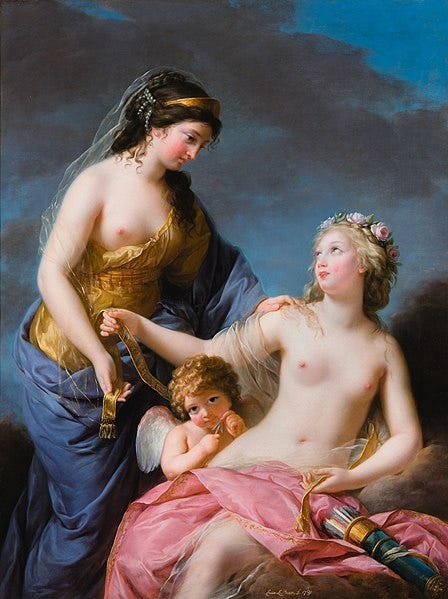
Hera (or Juno) is the Greek goddess of the sky, the stars, women and marriage, blessing unions, protecting families and aiding in childbirth. As queen of Olympus and sister-wife to Zeus, earthly power (such as political power) is also her blessing to bestow.
Hera has been largely misunderstood and maligned throughout history as a result of her penchant for exacting bitter vengeance on her husband’s cornucopia of lovers. As we discussed last week though, there’s more to it when a Greek god punishes a human than a simple show of cruelty, despotism, or jealousy.
Myths can also provide us with accurate descriptions of the civilizations that created them. The ascension of Olympian rule, following the fall of the Titans, is centered in the figure of the royal couple (Zeus and Hera). Even though Hera sits next to Zeus in the throne room of Olympus, she still has to answer to her husband. The mythical narratives that concern their relationship to each other and to the other gods can be viewed as depictions of a patriarchal society where women are often relegated to secondary roles.
Whenever I would discuss Hera’s myths with other nerds, many questions about her would arise. Why does she stay with her unfaithful, philandering husband? Why doesn’t she just walk away? The answer can be quite simple. Hera is queen, and as such, she has duties that come with her role within this patriarchal social order that she is not willing to abandon. She knows she has important work to do and refuses to sacrifice those who depend on her in order to pursue personal satisfaction.
“Uneasy lies the head that wears a crown.”¹
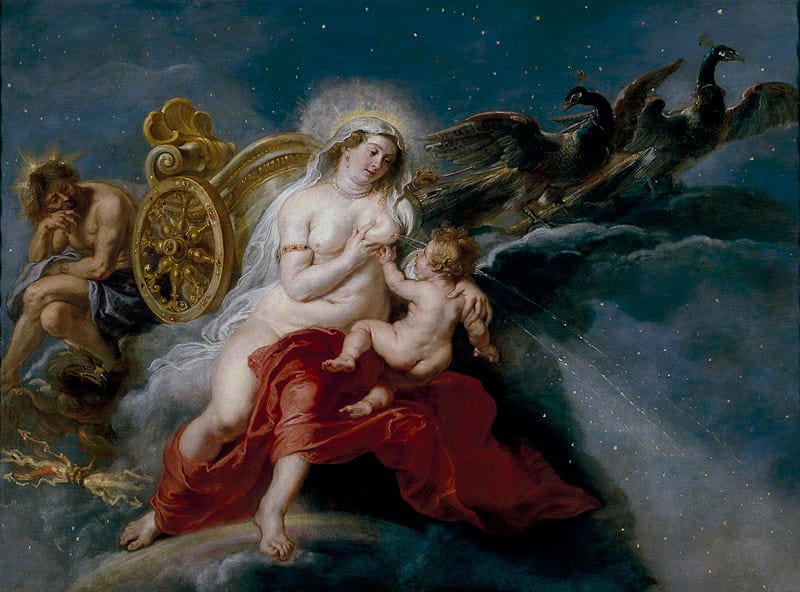
Hera is therefore bound by pragma (love based on logic and duty), storge (enduring love) and agape (divine love) to continue to perform her queenly duties, no matter how personally unhappy she may be.
Hera’s character and personality reflect a common archetype that has been vilified, slandered and hated on by the patriarchy for generations: the matron.
While the patriarchal man may love his own mother, he certainly harbors hatred for the mother of the young girl he hopes to prey on, or the Herculean solo mother he strives to defame. That species of predator’s overall goal in life is to lay waste to the divine protectress of the innocent and the vulnerable, which a goddess of childbirth like Hera undoubtedly personifies.
However bound by her responsibilities, there are a few episodes from mythology where Hera decided to go rogue and do her own thing (as much as the constraints of her position would allow).
One of those times was when she produced an heir without the help of her husband; creating her son Hephaestus, god of the forge, all by herself.
Hephaestus was born with a physical disability, so sadly the goddess assumed she had failed in her endeavour to create perfection and turned him away. Cast down from Olympus, Hephaestus lived a lonely life, with no marriage prospects or lovers, even though he was the son of the goddess of marriage herself.
Cut to Aphrodite. The Goddess of Beauty and Love emerged fresh from the sea, a fully formed, breathtaking woman. She was brought to life by an alchemical mixture of semen, blood, and salt water when the titan Ouranos had his testicles excised and flung on the ocean by his own son Chronos.
(The story of this dynasty is a field day for psychologists. I’ll leave them to it.)
Aphrodite, or Venus, was only a queen in the sense that she wielded power and control over the hearts and desires of every living thing. With no parents or rank forcing her to behave a certain way, the Goddess of Beauty did not seem bound to royalty in any sense. She came and went as she pleased.
“…delighting in the company of the dark-faced nymphs on land, as light-footed, they frisk over the sandy beaches”
-Orphic Hymn to Aphrodite²
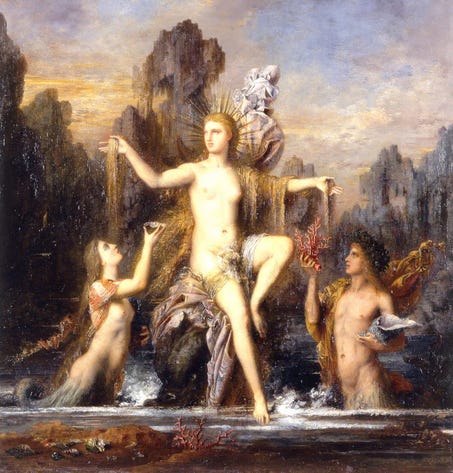
Enjoyment, intrigue and frolic were Aphrodite’s main concerns. No wonder she was given epithets (titles) such as philomides (laughter-loving), makhanitis (deviser of schemes), and antheia (friend of flowers). She was also known to have taken several lovers, doting on human men and gods with equal fervor; and to have roamed the earth, taking pleasure in watching and coreographing life’s lustful ballet.
In fact, one of her Roman epithets was libertina, which translates to freewoman.
However, we all know that there is no such thing as a free woman in a patriarchy.
One day, carefree Aphrodite was simply gifted to Hephaestus by Zeus as a prize for managing to free Hera from a divinely crafted torture device (a magical throne with the power to imprison gods). Foam-born Venus now belonged to a husband she had not chosen, by order of a man who did not care how she felt.
So the goddess did the only thing she could do: she engaged in civil disobedience.
Aphrodite, who was already involved with Ares, the god of war, continued her preexisting relationship, as she did not recognize the legitimacy of her arranged marriage. She had not consented to this union.
When Hephaestus started to suspect the affair, he used his divine craftsman abilities to create a net of gold so fine it was invisible, and proceeded to cast it upon their bed. One evening, when Ares and Aphrodite believed they were alone, Hephaestus waited until the couple abandoned themselves to love and then pulled on the net, entrapping the lovers and displaying their entanglement in front of all the other Olympians.
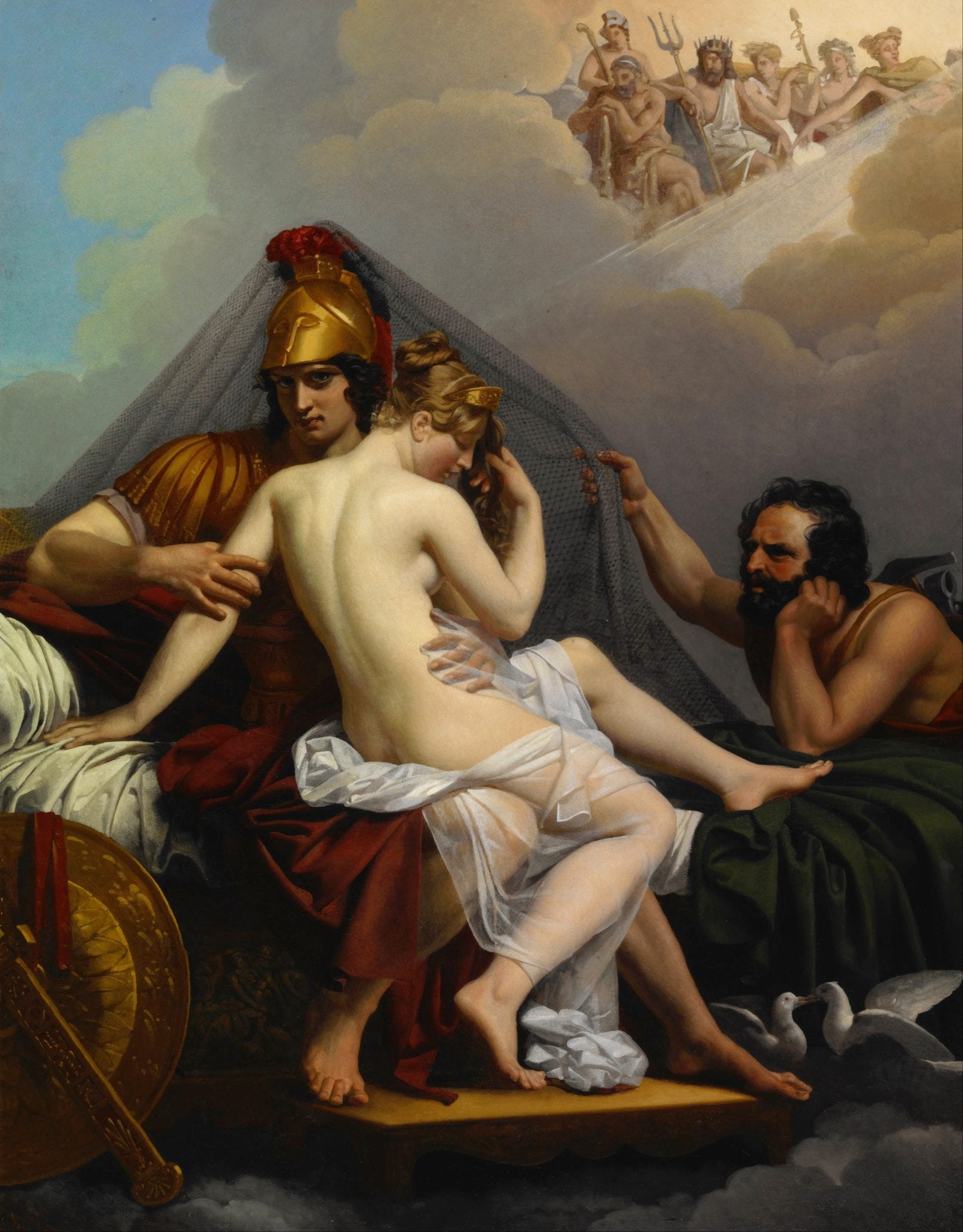
While trapped in the net, her naked form exposed for all the gods to see, Aphrodite had but one reaction: she laughed. She was not ashamed to betray a contract that had been forced upon her.
As we’ve discussed previously, the Greeks believed there were several types of love. Philautía (self-love) is what happens when one embodies the wisdom of their own worth. It is the resulting force of one’s mind, body, and soul joining together in the certainty that they did not rise from the spume of a castrated tyrant just to become someone’s property. In self love lies freedom.
A curious thing about this myth is that Aphrodite was later allowed to separate from Hephaestus (who eventually came to marry one of Aphrodite’s best friends), so she was now publicly emancipated to go live as the feral vixen she had always been.
One afternoon a couple years ago, I was in my kitchen crushing some flowers and other ingredients with a mortar and pestle in order to produce a self love spell that was passed down to me by an old friend.
The sound of the pestle hitting the mortar in a rhythmic way evoked a sing-song quality that reminded me of pontos de umbanda (ritual chants from an African diaspora religion I belong to, as discussed in a previous post).
After a while, the cadence of beating and crushing the herbs lulled me into an altered state of consciousness, where the words and melody to a love spell rose from my unconscious like Venus rising from the foam, naked and unblushing: free of shame or guilt of any kind.
Venus was never one to carry a cross, after all. She carries a mirror instead.
Juno also came to join us, as lifelong love is her specialty.
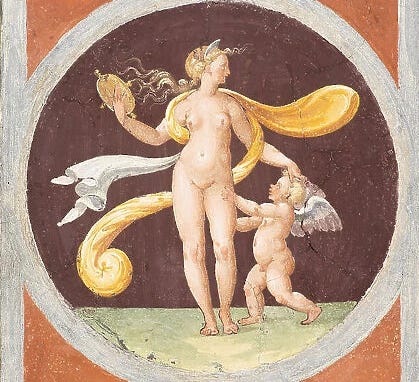
Feel free to use this spell however you like! It was made for you.
Love is within us. It never really goes away.
But if you ever happen to forget what it looks like, a mirror can surely help.
Love Spell
Instrumentals, mixing, and so much more by my band mate and parter-in-Art, Paul Conneally
In the name of the goddess Aphrodite
I brew this spell of love
In the name of the goddess
I release it to be carried by her dove
In the name of the goddess Aphrodite
In the name of Venus fair
I weave and bind this incantantion
In the red locks of her hair
In the name of the goddess Hera
Let the love be pure and strong
And the name of the Queen of Heavens
Be forever praised in song
Juno Regina
Venus Libertina
Could you hear the metallic sound of the mortar and pestle? It’s in there, hiding in plain sight thanks to Paul’s sonic sorcery 🧙
By the way, if you prefer your candy sour, here’s the acid pop remix of Love Spell, made by Wrath:
Cover art by the incomparable Trix.


Thank you so much for reading.
Have a lovely Venus day!
Love,
VA ♀
If you like my work, you can support me by liking and sharing this post! 🥰
In case you would like some merch, here’s the link to my teespring (I’ve kept prices there as low as possible).
To stream Venus Aphrodite on Spotify, Apple Music, etc, click here:
https://linktr.ee/v3nusaphrodit3
Images shown above:
2- “Birth of the Milky Way” by Peter Paul Rubens (1636-1637)
¹ William Shakespeare (King Henry IV).
²Translation of the Orphic Hymn to Aphrodite by A. Athanassakis
List of Aphrodite’s titles from theoi
Yeah! Great read!
Beautiful way to ring in Venus day with your post. Thank you! Also, you’re Brazilian! I just returned from a 2 month stay in Brazil. As an occultist, learning about Umbanda and Condomble was extremely eye opening. ✨... Happy Venus Day ❤️